THE RENOVA RECOVERY BLOG
Written by the Renova Recovery Editorial Team
Clinically reviewed by Rachele McGowan, LPC, LCADC, ACS, CCS, NCC, CCTP-II, ICGCI, Clinical Director
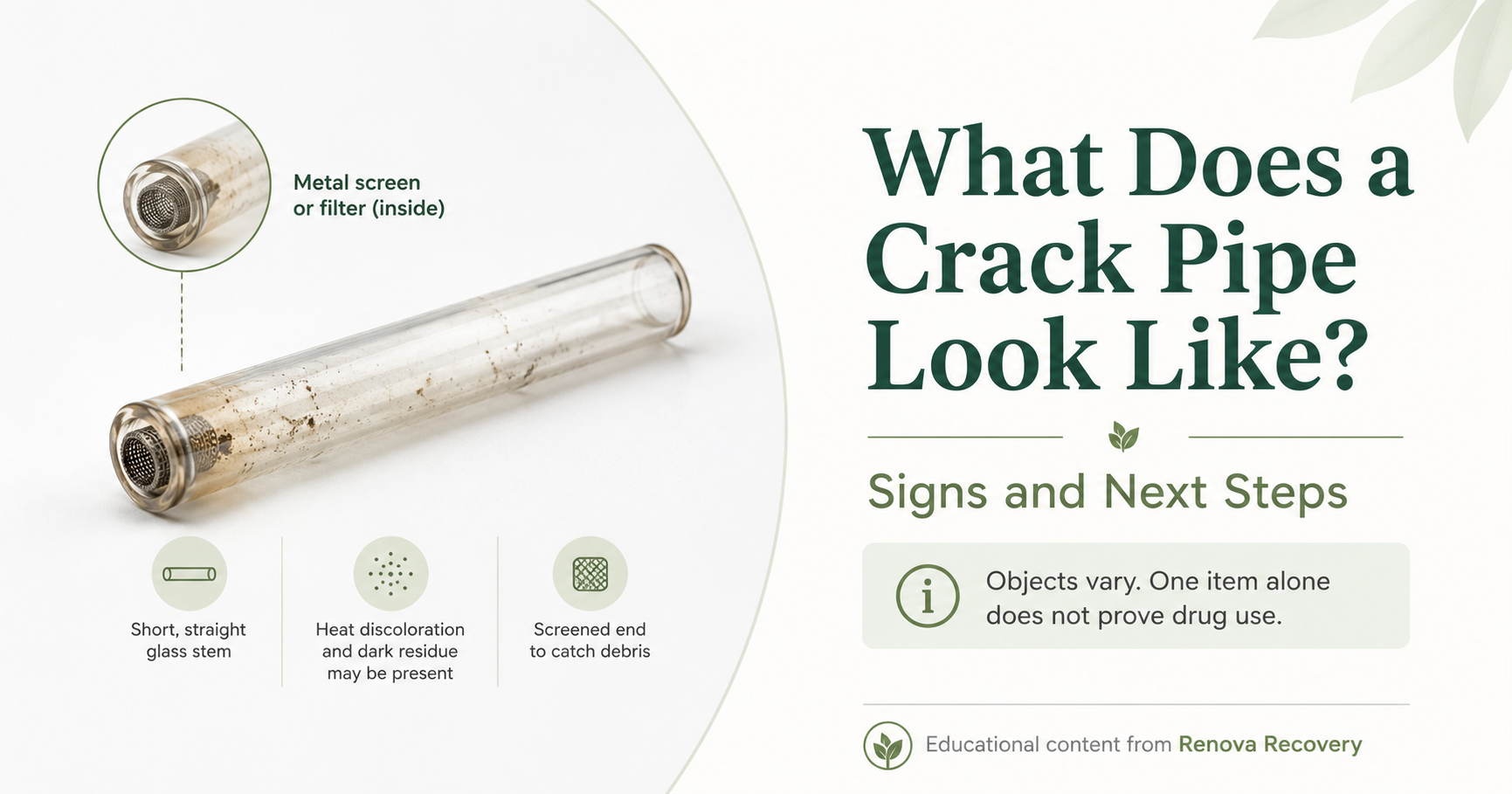
What Does a Crack Pipe Look Like? Signs and Next Steps
What Is a Crack Pipe?
Maybe you found a short glass tube in a pocket, backpack, drawer, or car. Maybe it has burn marks or residue, and you are trying to understand what it could be without immediately assuming the worst.
A crack pipe is often a short, straight glass tube or stem. A used pipe may look cloudy or darkened from heat, contain brown or black residue, or have a small metallic screen or steel-wool-like filter inside one end. However, improvised smoking devices can look different, and an object alone cannot confirm what substance was used or whether someone has an addiction.
This guide explains what you may be looking at, which additional signs matter, when the situation may be an emergency, and how to start a calm conversation.
Immediate emergency: Call 911 if someone has chest pain, a seizure, severe overheating, extreme agitation, collapses, cannot be awakened, or has slow, shallow, or stopped breathing. If opioid exposure is possible and naloxone is available, give it according to the package directions while waiting for emergency help.
What Does a Crack Pipe Look Like?
Research describing crack-smoking equipment commonly refers to straight glass stems used with metallic filters, including brass screens or steel wool. The filter helps hold the crack cocaine in place while it is heated.
Common characteristics may include:
- A short, straight glass tube or stem
- Heat discoloration, cloudiness, or dark residue
- Chipped, cracked, or rough glass near one end
- A small metallic screen or steel-wool-like material inside the tube
- Burn marks near the end where the substance was heated
- A lighter stored with the tube
Not every pipe looks the same. Some devices are improvised, and glass or metal objects can have ordinary household uses. It is safer to describe exactly what you found than to treat the object as proof.
If the glass is broken or has unknown residue on it, keep it away from children and pets. Avoid handling sharp edges or residue with bare hands, and do not smell, taste, or attempt to test an unknown substance yourself.
Crack Cocaine Paraphernalia: What Else Is Usually Nearby
One object rarely tells the whole story. Other items that may appear around cocaine or crack use include:
- Small plastic baggies or folded paper packets with powder or residue
- Rolled paper, hollow pen tubes, short straws, or rolled bills
- Small mirrors or flat surfaces with powder residue
- Lighters stored with a glass stem
- Several similar glass stems or metallic screens
- Unexplained white or off-white powder or small rock-like pieces
These items are not proof on their own. A lighter, small bag, straw, or piece of glass can have an innocent explanation. Context matters, especially when an object appears alongside behavior changes or repeated incidents.
Unfamiliar terms can also cause concern. Read our guide explaining [what an 8-ball of cocaine means].
/what-is-an-8-ball-of-cocaine
Signs of Crack Use
No single sign confirms crack use, and several below have ordinary explanations — stress, sleep problems and other medical conditions produce the same picture. What matters is a cluster appearing together, and a change from how the person usually is.
Physical: long stretches without sleep followed by heavy crashes; appetite loss and weight change; dilated pupils; burns or sores on the lips or fingers; a hoarse voice or persistent cough.
Behavioral: short bursts of intense energy and talkativeness followed by irritability and withdrawal; money disappearing without explanation; new secrecy about time and whereabouts; a social circle that changed quickly.
Environmental: short glass tubes, steel wool or scouring pads, small plastic bags, lighters used up unusually fast, burn marks on surfaces.
Signs of crack use are easy to misread in both directions. People miss them because the person functions well between uses, and people overreact to one sign with a benign explanation. Several of these together, representing a change, is worth an assessment — not an accusation.
How to Tell If Someone Is Using Crack
You cannot tell with certainty from the outside, and it is worth being honest about that before you act. What you can do is look at pattern rather than incident.
Three questions help more than a checklist. Has there been a change, and over what period? Stimulant use tends to produce a cycle — days of high activity, then a crash — rather than a steady state. Do the explanations hold up? Recurring inconsistencies about money, time or whereabouts tell you more than any single object. And is functioning slipping somewhere that used to be reliable — work, school, a responsibility they never used to drop?
A drug test answers a narrower question than most families expect: it tells you about recent use, not about dependence, and demanding one usually costs you the conversation. A clinical assessment answers the question you actually have — whether what is happening warrants treatment — and it does not require the person to admit anything first.
Finding a Pipe Does Not Automatically Prove Addiction
Finding possible paraphernalia can be alarming, but it does not tell you:
- What substance was used
- Who used the object
- How often use may be occurring
- Whether the person has a substance use disorder
- Whether the item has an innocent explanation
Try not to begin with a diagnosis or accusation. Focus first on immediate safety, then on gathering accurate information.
Pay closer attention when several changes appear together, become more severe, continue over time, or create a safety concern.
Possible changes associated with cocaine use can include:
- Periods of unusually high energy, restlessness, or rapid speech
- Irritability, anxiety, suspiciousness, or paranoia
- Major changes in sleep or appetite
- A noticeable “crash” marked by exhaustion or low mood
- Unexplained spending, missing money, or selling belongings
- Secrecy about whereabouts or abrupt changes in social circles
- Declining performance at work, school, or home
- Repeated unexplained absences
- Continuing to use despite health, relationship, work, or legal consequences
Many of these signs can also be caused by stress, depression, anxiety, another health condition, or ordinary life changes. A professional assessment is more reliable than trying to diagnose someone from a checklist.
Cocaine, Crack, and the Risk of Fentanyl Exposure
The illegal drug supply is unpredictable. The CDC warns that fentanyl is sometimes mixed with cocaine and methamphetamine, and the person using the drug may not know it is present.
The DEA’s 2025 National Drug Threat Assessment reported that National Forensic Laboratory Information System data found fentanyl in approximately one in four cocaine submissions analyzed by forensic laboratories. This does not mean that one in four cocaine products everywhere contains fentanyl. These were law-enforcement laboratory submissions, not a random sample of all cocaine in circulation. The finding still demonstrates that unexpected opioid exposure is a real risk.
Naloxone, commonly sold as Narcan, can reverse an opioid overdose. It does not treat cocaine toxicity, chest pain, seizures, overheating, or other stimulant emergencies. Call 911 whenever severe symptoms are present, even when naloxone is given.
When you are unsure whether opioids, cocaine, or more than one substance may be involved, call 911 and describe exactly what you are seeing.
Possible signs of an opioid overdose
- The person cannot be awakened
- Breathing is slow, shallow, irregular, or stopped
- Lips or fingertips appear blue, gray, or unusually pale
- The body is limp
- There are choking, gurgling, or snoring-like sounds
- Pupils may be very small
Possible signs of a stimulant emergency
- Chest pain
- Seizure
- Severe agitation, panic, or confusion
- Hallucinations or psychosis
- Very fast or irregular heartbeat
- Dangerous overheating
- Rigid or jerking limbs
- Collapse or loss of consciousness
How to Start the Conversation
Do not begin the conversation while the person appears intoxicated, severely agitated, or medically unstable. Address urgent safety first.
When the person is calm:
- Choose a private moment. Avoid confronting them in front of siblings, children, coworkers, or friends.
- Describe what you found without exaggerating. You might say, “I found this glass tube with burn marks, and I am concerned. I want to understand what it is.”
- Ask open questions. Try, “Can you tell me what has been happening?” rather than beginning with a demand for a confession.
- Listen before deciding what it means. The explanation may not remove your concern, but listening gives you better information and reduces the chance that the conversation immediately shuts down.
- Set clear safety boundaries. It is reasonable to say that drugs, intoxicated driving, or unsafe behavior cannot occur in your home or around children.
- Focus on the next useful step. Depending on the situation, that may be a medical evaluation, substance-use assessment, mental-health assessment, naloxone access, or a conversation with an addiction professional.
Avoid promising secrecy when someone is in immediate danger. Do not try to physically restrain a person who is severely agitated or paranoid. Call emergency services when there is a risk of violence, medical collapse, or serious injury.
When It Is Time to Involve a Professional
A professional assessment is appropriate when:
- You have found paraphernalia more than once
- Cocaine or crack use has been acknowledged
- Use appears to be increasing
- There has been an overdose or emergency-department visit
- The person has chest pain, severe anxiety, paranoia, depression, or suicidal thoughts
- Work, school, finances, relationships, or housing are being affected
- The person has tried to stop but continues returning to use
- Alcohol, opioids, benzodiazepines, or other substances are also involved
- Family conversations repeatedly end without a workable safety plan
- Where the household is also under strain,
family therapy for addiction runs alongside the client's program.
→/family-therapy
An assessment does not automatically mean residential treatment. The appropriate level of care depends on substance use, medical and psychiatric stability, withdrawal risk, living environment, and the person’s ability to participate safely in outpatient services.
What Ocean County Families Should Know
In 2024, Ocean County faced significant challenges with substance use, particularly concerning cocaine. Understanding these statistics can help families navigate the complexities of addiction and seek the right support.
We keep a current list of addiction resources in Ocean County, including crisis lines and county services.
How Renova Recovery Can Help
Renova Recovery provides Partial Care, Intensive Outpatient, and standard Outpatient treatment for adults age 18 and older in Brick, New Jersey. Treatment can address cocaine use along with anxiety, depression, trauma-related symptoms, and other co-occurring mental-health concerns.
When you call, you do not need to know which level of care is appropriate. Our admissions team can listen to what has been happening, explain the assessment process, and help determine whether Renova’s outpatient services may be a suitable fit.
If the person is under 18, seek an adolescent substance-use treatment provider or pediatric behavioral-health professional. If anyone is in immediate danger, call 911.
Read More
→
/cocaine-rehab-brick-nj
Concerned About Cocaine Use?
Speak confidentially with our admissions team about what you found, what has been happening, and whether a professional assessment may help.
Frequently Asked Questions
Can you identify crack cocaine from a pipe alone?
No. A pipe may suggest possible drug use, but its appearance cannot confirm which substance was used, who used it, how often it was used, or whether the person has a substance-use disorder.
Are crack pipes always made of glass?
Glass stems are common, but improvised devices may be made from other materials. Because appearance varies, it is best to consider the full context rather than relying on one feature.What should I do if there is unknown powder or residue?
Keep children and pets away. Do not smell, taste, burn, or attempt to test it yourself. Avoid touching residue or broken glass with bare hands. Contact emergency services when someone may have been exposed and is showing symptoms.Can naloxone help if the person thought they used only cocaine?
Naloxone can reverse an opioid overdose if fentanyl or another opioid is present. It will not treat stimulant toxicity, so call 911 whenever someone cannot be awakened, is breathing abnormally, has chest pain, experiences a seizure, or shows other severe symptoms.Does finding a crack pipe mean the person needs rehab?
Not automatically. It means the situation deserves a calm conversation and may justify a professional assessment. The right recommendation could range from education and monitoring to outpatient, residential, medical, or emergency care depending on the full assessment.
In 30 seconds
- If the person is unresponsive, struggling to breathe, or having a seizure — call 911 now. Do not wait to find out what they used.
- What it usually looks like — A short straight glass tube or stem, often cloudy or darkened from heat, sometimes with brown or black residue and a small metal screen or steel-wool filter inside one end.
- What else is often nearby — Steel wool or scouring pads, small plastic bags, lighters, burn marks on surfaces.
- What it does not prove — An object is not a diagnosis. Finding one tells you something was likely used. It does not tell you by whom, how often, or whether there is an addiction.
- The risk people underestimate — Cocaine and crack are increasingly contaminated with fentanyl. Someone who believes they used only a stimulant can still overdose on an opioid.
- What to do first — Do not open with the object. Confronting someone with what you found usually ends the conversation before it starts.
- To get an actual answer — A confidential assessment tells you whether what you are seeing warrants treatment. Call (908) 533-9808, answered 24/7.
Sources
Place these at the bottom in a smaller font, but keep them readable:
- U.S. Drug Enforcement Administration — 2025 National Drug Threat Assessment
- Centers for Disease Control and Prevention — 5 Things to Know About Naloxone
- Centers for Disease Control and Prevention — Stimulant Guide
- https://nj.gov/humanservices/dmhas/documents/pdf/statistical/substance-abuse-overview/2024/Oce.pdf
- Diak BJ, et al. — Research on brass screens and steel wool used as crack-smoking filters
- MedlinePlus — Cocaine