We got it.
Hi,
Thank you for reaching out to Renova Recovery.
We’ve received your message and a member of our team will be in touch with you shortly. If you’d prefer not to wait, you’re welcome to call us directly at (908) 533-9808 and we’ll help you right away.
We’re glad you reached out and look forward to speaking with you.
Sydney
Renova Recovery
Outpatient Drug & Alcohol Treatment Center
SERVING TOMS RIVER · OCEAN COUNTY
Drug Rehab Serving Toms River, NJ
Renova Recovery is a Joint Commission accredited outpatient drug rehab treating heroin, fentanyl, cocaine, methamphetamine and prescription drug addiction for adults in Toms River and across Ocean County.
Care runs through our Partial Hospitalization Program (PHP), Intensive Outpatient (IOP), Outpatient (OP) and Medication-Assisted Treatment, at our Brick Township center 5 to 15 minutes from Toms River. Morning, afternoon and evening groups mean most clients keep working while they get well.
Answered 24/7. No charge, and nothing is committed to on the call.


5.0 ★★★★★ Google reviews
17 Google reviews
every one of them five stars.
Renova Recovery has exceeded my expectations. As an outpatient facility, they offer flexible and personalized care. The staff is compassionate, knowledgeable, and genuinely invested in your recovery.
Hershy D.
Google review
Nice friendly workers here at Renova. They go above and beyond to help you succeed with getting sober. Would highly recommend to anyone looking for treatment.
Kayla K.
Google review
I was looking for a Treatment center near me that i could get better that offered a program with a process, I am so glad i chose Renova, I started PHP it was intense yet necessary and doable, and most importantly kept me sober, I graduated to IOP, Now I'm finally doing OP. Driving up from Toms River was easy and there is plenty parking.
Sean E
Google review
THE NUMBERS
Drug Addiction in Toms River: What the State Data Shows
Ocean County was one of the hardest-hit counties in New Jersey's opioid crisis, and Toms River, as the county seat and its largest town, has carried a heavy share of it. Anyone who has lived here through the last decade knows a family that lost someone. According to the state's Division of Mental Health and Addiction Services, heroin and other opioids sit alongside alcohol at the top of the list of substances sending Ocean County residents into treatment, and fentanyl has made the street supply more dangerous than it has ever been. Pills bought outside a pharmacy, powder sold as cocaine, counterfeit Percocet and Xanax: in today's Ocean County, assuming any of it is what the seller says it is can be a fatal mistake.
The response here has been real, too. This is a county where police departments helped pioneer walk-in treatment referral through the Blue HART program, where Narcan is stocked and used, and where a strong local recovery community has grown out of hard losses. Help is not far away and it is not theoretical. For most of Toms River, it is a fifteen-minute drive.
That is the context this page is written in. Not to scare anyone, but because people in this town have earned straight talk.
1,500
treatment admissions by Toms River residents in 2024 — the most of any town in Ocean County
#1 of 33
Toms River ranks first among Ocean County's 33 municipalities for treatment admissions — ahead of Brick (755) and Berkeley (508)
+44%
rise in cocaine treatment admissions by Toms River residents in one year (102 in 2023 → 147 in 2024)
~1 in 2
Ocean County residents who entered treatment in 2024 were treated outside Ocean County
What Toms River residents entered treatment for
| Substance | 2024 admissions | Share | vs. 2023 |
|---|---|---|---|
| Alcohol | 687 | 46% | up from 574 |
| Heroin | 448 | 30% | up from 422 |
| Cocaine / crack | 147 | 10% | up from 102 |
| Other opiates (pills) | 90 | 6% | down from 96 |
| Marijuana | 36 | 2% | up from 32 |
| Methamphetamine | 30 | 2% | down from 34 |
| Other | 62 | 4% | — |
| Total | 1,500 | 100% | up from 1,318 |
Source: NJ Division of Mental Health and Addiction Services, Substance Use Overview 2024, Ocean County (NJSAMS)
Cocaine is the fastest-rising drug in Toms River
Countywide, cocaine treatment admissions climbed from 317 in 2022 to 519 in 2024, a 64 percent jump in two years, and Toms River alone accounts for 147 of them — more than one in four cocaine admissions in the entire county. If cocaine is your struggle, you are part of the fastest-growing group walking through our doors, and our cocaine treatment program is built for exactly this.
"Heroin" admissions are falling, but not because opioids got safer
County heroin admissions dropped from 2,509 in 2022 to 1,997 in 2024. The catch: what's sold on the street today is largely fentanyl, and it increasingly carries veterinary sedatives like xylazine and medetomidine that Narcan cannot reverse. Fentanyl also shows up in counterfeit pills and in stimulants, which means people who never sought opioids are being exposed to them. Fewer admissions does not mean less danger. It means less margin for error, and if you use anything bought outside a pharmacy, carry Narcan.
Every age group is in these numbers
Of Ocean County's 6,708 admissions in 2024, over a thousand — 15 percent — were people 55 and over, a number that matters in a town with some of the largest retirement communities in New Jersey. The largest single group was ages 35 to 44: working adults with jobs and families. Whatever your age and situation, you are represented in this data, which is another way of saying you are very far from the only one.
One more number worth sitting with: only about half of the Ocean County residents who entered treatment in 2024 were treated inside Ocean County. Nearly one in five ended up at Monmouth County facilities and more than one in ten in Atlantic County. Hundreds of people from this area drive 40 minutes to an hour each way for care, or leave home entirely, for treatment that exists fifteen minutes from Toms River. Closing that gap is the reason this page exists.
The response here has been real, too. This is a county where police departments helped pioneer walk-in treatment referral through the Blue HART program, where Narcan is stocked and used, and where a strong local recovery community has grown out of hard losses. The numbers above are heavy, but they all point the same direction: in Toms River, help is not far away and it is not theoretical.
Source: NJ Division of Mental Health and Addiction Services, Substance Use Overview reports for Ocean County, 2022–2024 editions (NJSAMS data). Figures reflect treatment admissions by municipality of residence. Report: nj.gov/humanservices/dmhas/documents/pdf/statistical/substance-abuse-overview/2024/Oce.pdf
SOUND FAMILIAR?
Who Comes to Us From Toms River
No two clients are alike, but after enough intakes from the same town, patterns emerge. If you recognize yourself or someone you love below, this page is for you.
The working adult holding it together. A trade, a commute up the Parkway, a mortgage in North Dover, and a cocaine or pill habit that started as weekend relief and quietly became the week itself. Nobody at work knows. Evening IOP exists precisely for this person.
The young adult caught by fentanyl. What began with pills at parties or after a sports injury is now opioid dependence, and in today's supply, every use is a coin flip. Parents are often the ones making the first call, and we take those calls seriously.
The older adult in the retirement communities. Toms River has one of the largest concentrations of 55-and-over communities in New Jersey, and prescription dependence, on painkillers after a surgery or benzodiazepines for sleep and nerves, is far more common there than anyone discusses at the clubhouse. Renova is an adults-only program; a 68-year-old in our groups is not unusual and is never out of place.
The person in a seasonal economy. Shore-town work runs hot in summer and empty in winter, and both halves feed use: the money and party culture of the season, the boredom and worry of the off-season. Treatment that understands that rhythm plans for it.
The person coming back after a slip. Sober for a year, two years, five, and using again after a loss or an injury. Returning to treatment is not starting over; it is bringing everything you already learned to a program that will build on it.
RECOGNIZING IT
Signs It's Time for Drug Treatment in Toms River
Drug addiction rarely announces itself. It may be time to consider treatment when use is happening more often or in larger amounts than intended, when stopping feels impossible despite real attempts, or when use continues through consequences at work, at home, with money, or with health. Becoming secretive about use, mixing substances, needing more for the same effect, using to get through stress or emotions, and returning to use after a period of stopping are all strong signs that professional support is needed.
Two Toms River-specific notes. First, if opioids are involved, waiting is more dangerous than it used to be; fentanyl has removed the margin for error that heroin users once had. Second, nobody has to lose everything first. Most of the adults we treat still have jobs, families, and lives they are actively protecting. That is exactly what outpatient treatment is for.
BEFORE YOU START
Do You Need Detox First?
Renova Recovery is an outpatient program. We do not provide on-site medical detox, inpatient, or residential treatment, and we won't pretend otherwise on the phone.
Whether detox is needed first depends on the substance and the situation. Withdrawal from opioids like heroin and fentanyl is intensely uncomfortable and often benefits from medical support. Withdrawal from benzodiazepines or heavy daily alcohol use can be medically dangerous and needs supervised care. Stimulants like cocaine and methamphetamine usually don't require medical detox, though severe depression or safety concerns still call for a higher level of care first.
During your first call, our team helps sort out honestly which situation you're in. If detox or inpatient care is needed first, we'll say so plainly, help coordinate a placement, and pick you up on the other side, usually within days. If outpatient care is appropriate now, you can often start within a day or two.
If you or someone you're with is experiencing an overdose, seizure, or thoughts of suicide, that is a medical emergency. Call 911 or go to Community Medical Center at 99 Route 37 West, open 24 hours.
A COMMON QUESTION
Do You Have to Leave Toms River to Get Real Treatment?
Plenty of Ocean County families have been pitched the out-of-state route: fly to Florida or somewhere warm, disappear for 30 days, come back new. For some situations, residential care genuinely is the right call, and we will tell you when your assessment says so.
But for a large share of people, the research and our experience point the same direction: recovery built inside your real life tends to hold up better than recovery built a thousand miles from it. In outpatient treatment you face your actual triggers, the same streets, the same stresses, the same Friday nights, while you have a clinical team beside you, instead of meeting them all at once at the airport on the way home. You keep your job. You stay with your kids. Your family can be part of treatment instead of waiting by the phone.
There's a practical version of this logic, too. Daily or near-daily attendance is the engine of PHP and IOP, and attendance is a function of distance. Fifteen minutes up Hooper Avenue is a commitment you can keep in January, after a double shift, when it's raining. The farther treatment is from your driveway, the easier it becomes to skip, and skipping is how outpatient treatment fails. We built Renova in Brick because it puts real treatment inside the daily reach of Toms River, and that is not a compromise. It is the design.
And if home is part of the problem: some people need distance from their living situation more than they need to leave Ocean County. For clients whose home environment works against recovery, we help arrange sober living, structured substance-free housing that pairs with PHP or IOP, so you get the separation of going away with the treatment continuity of staying local. Ask about it on your first call.
CONDITIONS
Drug Addictions We Treat
OUR APPROACH
Drug Treatment in Toms River: How Our Program Works
Recovery is more than stopping. Treatment at Renova helps clients understand the patterns underneath their drug use, manage cravings, recognize their personal triggers, and build better responses to stress and difficult emotions.
Every client works from an individualized plan built at intake from a full clinical assessment. The core of it is evidence-based therapy: cognitive behavioral therapy to catch and change the thinking that leads to use, dialectical behavior therapy skills for emotional regulation and distress tolerance, motivational interviewing for the days when motivation runs low, and structured relapse-prevention planning built around your specific people, places, and pressure points. Individual counseling and case management start in week one, alongside group therapy, where most of the real change happens.
Because most drug use overlaps with anxiety, depression, or trauma, dual diagnosis care is part of the standard program rather than an add-on. Our therapists are licensed to treat trauma, and clinical programming is overseen by Clinical Director Rachele McGowan, LPC, LCADC, ACS, CCS, NCC, CCTP-II, ICGCI. For opioid use, Medication-Assisted Treatment with Vivitrol, a once-monthly, non-addictive injection administered on site, can run alongside any level of care to reduce cravings while the therapy work happens.
LEVELS OF CARE
Outpatient Drug Rehab Programs for Toms River Residents
We run four levels of care for drug addiction. Which one you start at comes out of a clinical assessment — what you have been using, how long, and what withdrawal looks like — not what you can afford or how much time you think you can spare. Most people move down through more than one as they stabilize.
MOST STRUCTURED
Partial Hospitalization Program (PHP)
The most structured care we offer: clinical programming most of the day, most days of the week, while you sleep in your own bed. PHP is often the right starting point after a medical detox from opioids, benzodiazepines or alcohol, or when outpatient care alone has not held. Days combine group therapy, individual sessions, medical and psychiatric oversight, and relapse-prevention skills work.
outpatient drug rehab at the PHP level →
Most common
Intensive Outpatient (IOP)
Several group and individual sessions each week, scheduled so you can keep working. This is where most Toms River clients spend the bulk of drug treatment — heroin, fentanyl, cocaine, methamphetamine and prescription drug use are all treated at this level. Intensive enough to change something, light enough to survive a full-time job
Lightest commitment
Outpatient (OP)
Lower-frequency individual and group therapy for people who are stable and intend to stay that way. Usually a step down from IOP rather than a place to start, and often where people stay for months while cravings and triggers get tested against real life.
Runs alongside
Medication-Assisted Treatment (MAT)
Vivitrol (naltrexone) with counseling to blunt opioid cravings, injected on site. It requires being fully through withdrawal first, so it usually follows detox. Pairs with any level above. There is no equivalent medication for cocaine or methamphetamine — that work is behavioral.
COURT & WORK
Court-Ordered Drug Treatment in Ocean County
The Ocean County courthouse complex sits in downtown Toms River, and a meaningful share of our clients arrive with a legal reason attached: a probation condition, a drug court requirement, a pretrial intervention program, or a charge their attorney says will go better with treatment underway. We handle it routinely. Renova provides enrollment verification, attendance documentation, and progress reports to courts, probation officers, and attorneys, with your written consent, in the format they require. Being court-referred doesn't change how you're treated here; the program is the same, and plenty of clients who arrived because a judge said so left glad they came.
For working adults, IOP and OP schedules are built to coexist with a job, and federal law protects most employees who seek treatment. If you're worried about your license, your CDL, or a professional certification, raise it on the first call. We've navigated most versions of that question.
Ocean County's Intoxicated Driver Resource Center is at 732-341-9700 ext. 7500. If a court, a probation officer or the IDRC has directed you to get an evaluation or enter treatment, say so on your first call. It changes how the assessment is scheduled and what needs to be set up from the start.
Privacy
Addiction treatment records carry protections beyond ordinary medical privacy under federal law. Nothing goes to an employer, a court or a family member without your written authorization.
FOR FAMILIES
When You're Calling About Someone Else
A large share of our first calls come from a parent, spouse, or sibling in Toms River, not from the person using. That call is worth making. We can walk you through what treatment would look like, how to verify insurance quietly, and how to raise the subject without starting a war. You cannot force an adult into outpatient treatment, but families change outcomes: how you respond to use, what you fund, what you tolerate, and what you say all shift the odds.
You also don't have to carry it alone. Toms River is home to HOPE Sheds Light, a local nonprofit built by families who lost sons to this disease, offering family support and recovery community programs right in town. Nar-Anon and Al-Anon meetings run weekly across Ocean County. Your person's recovery may take time; your support can start today.
See it before you commit
Our Center
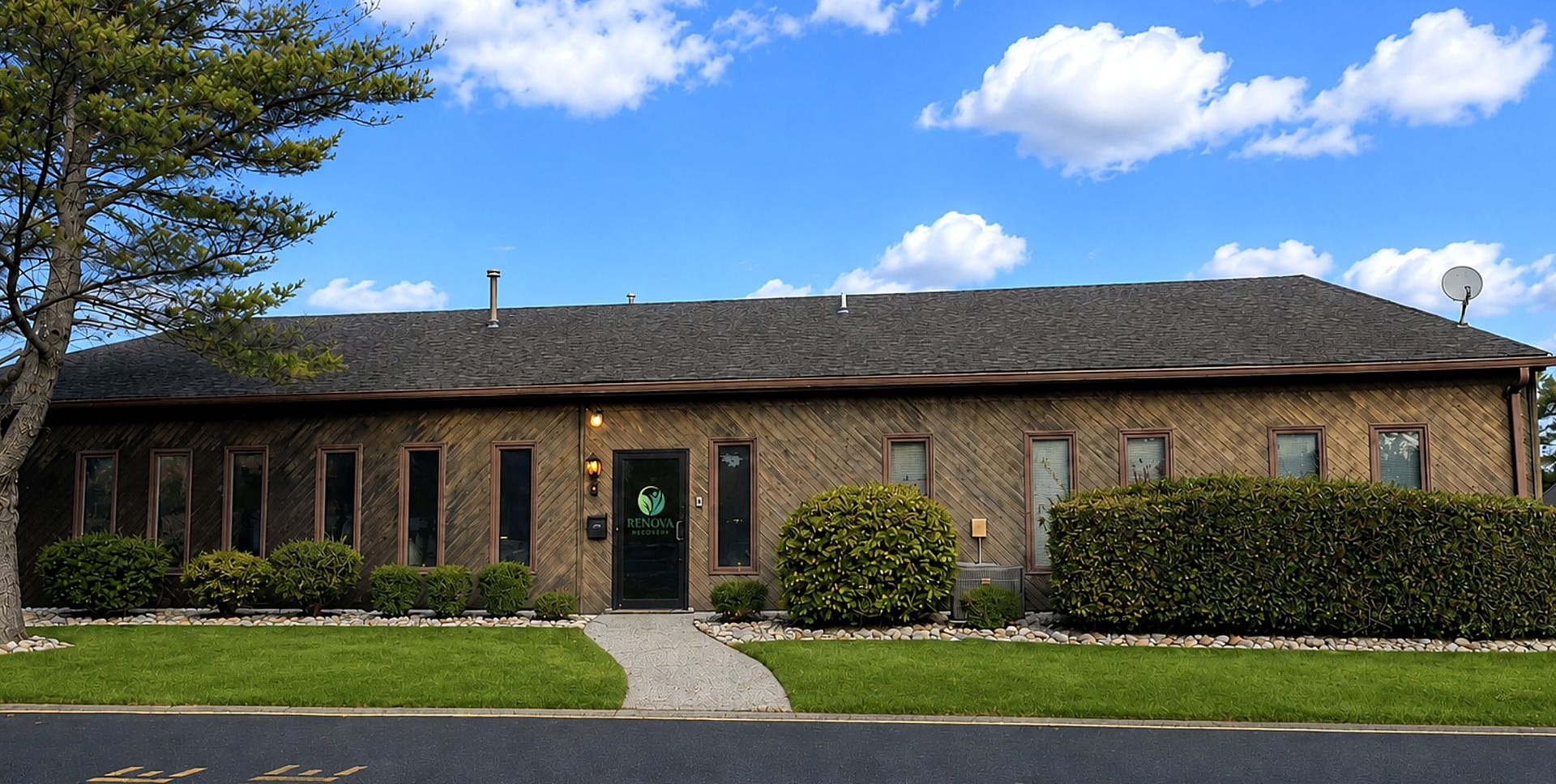
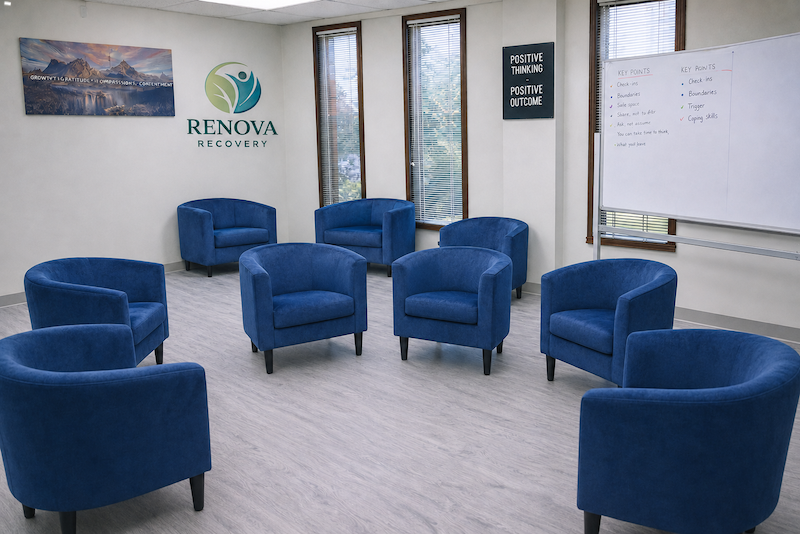
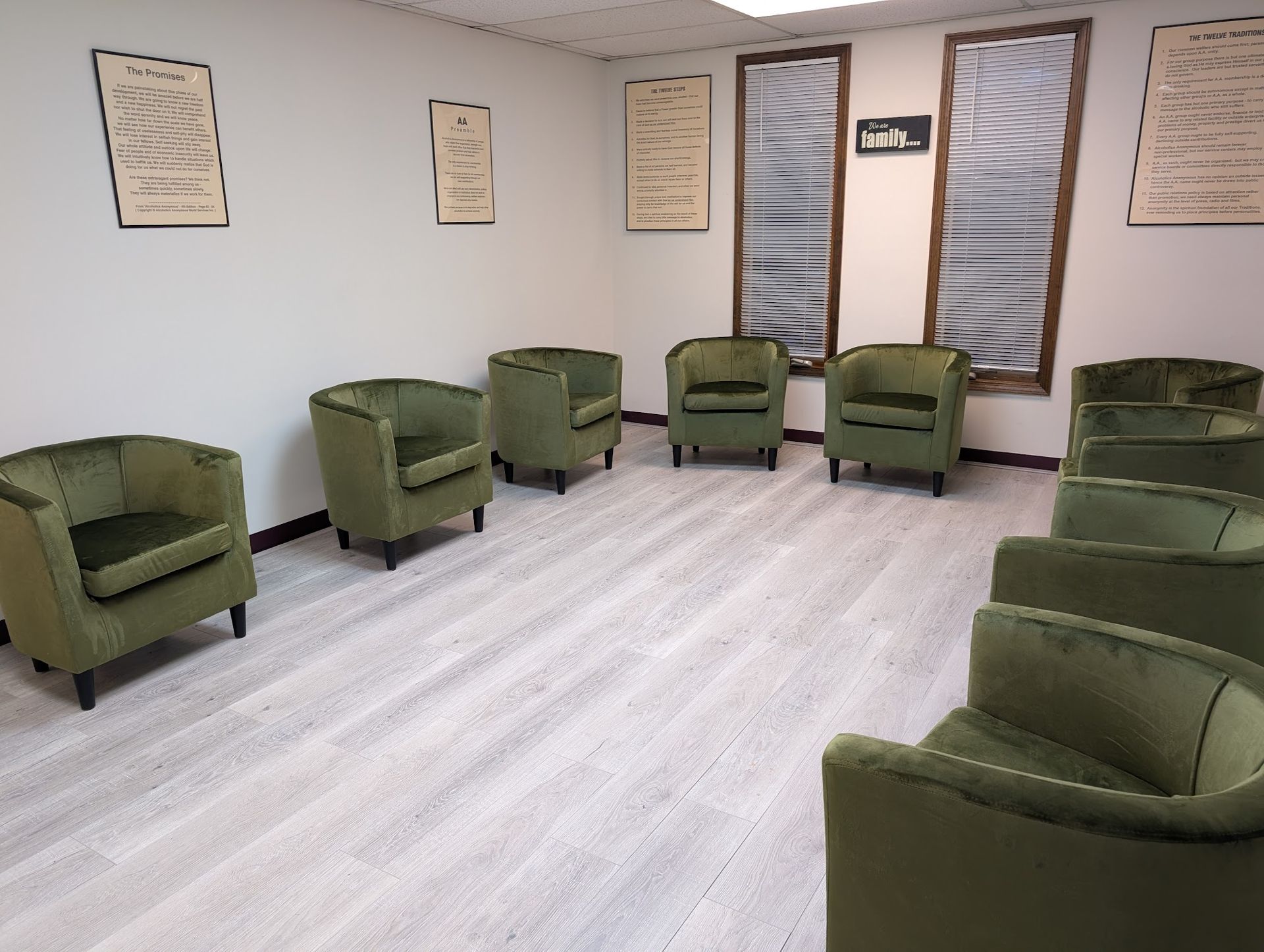
One building, one program, no campus to get lost in. Come look at the group rooms and meet an admissions counselor before you decide anything. Walk-ins welcome during business hours.


THE DRIVE
Getting here from Toms River
We are at 35 Beaverson Blvd, Building 6A, just off Route 70 in Brick
5 minutes from Silverton and North Dover, about 15 from downtown and the south side.
Parking is free and directly outside the building, so a three-day-a-week schedule stays a three-day-a-week schedule.
Turn-by-turn directions from each Toms River neighborhood are on our addiction treatment in Toms River
page.
No car right now, or a license issue?
Say so when you call. It comes up often
and it is usually more solvable than people expect.
STARTING TREATMENT
Starting Outpatient Rehab in Toms River: Your First Two Weeks
Most people calling us have never done this before. Here is the actual sequence from first call to second week of drug treatment, so nothing lands on you cold. Toms River residents typically start within a day or two of calling. There is no waitlist.
Day one
Intake assessment and insurance verification
- Confidential phone assessment, usually same day
- We verify your insurance and tell you the real cost before you start
- Clinical assessment sets your level of care — PHP, IOP, OP or MAT
- You get your start date and your schedule in writing
Week one
Therapy, groups and medication-assisted treatment
- You are assigned your own therapist — individual sessions start now
- Case manager meets you and starts on work, benefits, and housing if needed
- Medical review, and MAT if it is clinically appropriate
- Group therapy begins on your chosen track
Week two
Treatment plan review and relapse prevention
- Treatment plan reviewed and adjusted with you, not at you
- Family session offered if you want your people involved
- Trigger and craving mapping — the people, places and routines tied to using
- Schedule adjusted if it is clashing with work or childcare
Treatment plan reviewed and adjusted with you, not at you Family session offered if you want your people involved Relapse-prevention work starts Schedule adjusted if it is clashing with work or childcare
Most Toms River residents are in treatment within 24 to 48 hours of the first call.
If you are calling for someone else,
start the same way — we will walk you through it.
OCEAN COUNTY
Drug Addiction Help and Crisis Resources in Toms River, NJ
Not everything you need comes from us. These are the services Toms River residents use most, whether or not you ever call Renova. Several are right in town.
In Toms River
• Ocean County Health Department — Substance Abuse, Addiction & Opioid Dependency, 732-341-9700, 175 Sunset Ave
• Intoxicated Driver Resource Center (IDRC), 732-341-9700 ext. 7500
• HOPE Sheds Light — Toms River-based recovery community and family support nonprofit
• Community Medical Center emergency department — 99 Route 37 West, 732-557-8000, open 24 hours
Walk-in police referral
• Blue HART — the police-assisted treatment referral program pioneered in Ocean County lets residents walk into a participating police department and ask for help getting into treatment. Brick Township PD was among the first in the state.
Free peer support
• Narcotics Anonymous — Ocean Area of NJ meeting list (link)
• Alcoholics Anonymous — Ocean County meeting list (link)
• Nar-Anon and Al-Anon — for family members (links)
24/7 helplines
• 988 Suicide & Crisis Lifeline — call or text 988
• ReachNJ addiction hotline — 1-844-732-2465
• NJ Connect for Recovery — 1-855-652-3737
• Medical emergency or overdose — call 911
We keep a fuller list, including free Narcan locations, housing, transport and veterans services, on our
Ocean County resource guide. You don't need to be our client to use any of it.
THERAPY SERVICES
Therapies Used in Our Drug Rehab Programs
Every Toms River client gets a personalized treatment plan built from a full clinical assessment. These are the therapies that plan is built from, each covered in more depth in our guide to addiction therapy.
One-on-one
Individual Therapy
Your own therapist from week one, weekly at minimum, more often at higher levels of care..
Peer setting
Group Therapy
The core of PHP and IOP. Morning, afternoon and evening groups so the schedule fits a working week.
Evidence-based
Cognitive Behavioral Therapy (CBT)
Identifying the thought patterns that precede a drink or a use, and changing what happens next.
Evidence-based
Dialectical Behavior Therapy (DBT)
Distress tolerance and emotion regulation, for people whose using has always been about turning the volume down.
Maintenance
Relapse Prevention Therapy
Naming the specific situations that will come, and having a plan for each of them before they arrive.
Relapse prevention →
Partners
Couples Therapy
For partners who have been managing this together, badly, for years.
Family system
Family Therapy
Addiction runs through a household. Family sessions are offered from week two if you want your people involved.
Medical support
Medication-Assisted Treatment (MAT)
Medication alongside the therapy above, for alcohol or opioid use disorder, when the assessment says it will help.
Evidence-based
Motivational interviewing
Used from the first call, particularly with people who arrived because of a court, a spouse or an employer rather than their own decision.
CHOOSING A LEVEL
Outpatient vs. Inpatient Drug Rehab
Thirty days away is the picture most people have of rehab, and for a Toms River household it is usually the reason nobody goes. Eighty-seven percent of Jackson households own their home. More than a quarter of residents are under 18. The person who calls us has a mortgage, a commute and children who need someone at pickup, and being told the only real option starts a month from now with a leave of absence is often where the conversation ends.
Outpatient works well when
- You are medically stable and not at risk of a dangerous withdrawal
- You have somewhere safe and sober to sleep
- You have a job, a family or a lease that needs you present
- You want recovery built inside the life you will actually live afterwards
Inpatient or detox first when
- Withdrawal carries medical risk, particularly with alcohol or benzodiazepines
- Home is not a safe or sober place to be
- Outpatient has been tried more than once and has not held
- There is acute psychiatric risk that needs 24-hour monitoring
We will tell you honestly if we think you need a higher level of care than we provide, and we will help you find it. But for a great many people in Toms River, outpatient is not the compromise option. It is the better clinical one.
PAYING FOR IT
Insurance & cost
We work with most major commercial plans. Federal parity law requires most plans to cover substance use treatment comparably to medical care, but what that means for your deductible varies plan to plan.
Call and we will run your benefits while you are on the phone, then tell you the actual number. No estimate that quietly changes later.
Before you call, have handy.
- Your insurance card, front and back
- Date of birth of the person seeking treatment
- Any substances involved, and roughly how long
- Any past treatment, if there has been any
Don't have your card? Call anyway. We can usually find the plan.
Cost
For most people with commercial insurance, outpatient rehab costs whatever their plan's deductible and coinsurance come to, not a sticker price. Renova operates out of network with commercial PPO plans, which means your plan still covers treatment, but the share you pay depends on your out-of-network deductible, your coinsurance percentage and how much of the deductible you have already met this year.
Does insurance cover rehab?
Almost always, yes. The Mental Health Parity and Addiction Equity Act requires most commercial plans to cover substance use treatment on comparable terms to medical and surgical care. They cannot impose a harder deductible, a lower visit cap or a stricter authorization process on addiction treatment than they do on a knee replacement. What varies is the size of your deductible and your coinsurance, which is why a general answer is worth very little and a benefits check is worth a lot.
What "out of network" actually means for you
Out of network does not mean uncovered. It means Renova has not signed a contracted rate with your insurer, so your plan pays against its own out-of-network schedule. For many PPO plans the practical difference to the patient is modest, and for some it is nothing once the deductible is met. For HMO and some marketplace plans it can be substantial. The only way to know is to have someone read your specific plan.
How we tell you the number
You call, we run a verification of benefits while you are still on the phone, and we tell you what your plan actually pays and what your share comes to. It takes minutes, it is free, and it does not commit you to anything. We would rather you knew the real figure before you started than found it in a statement six weeks in.
Cost compared with inpatient
Outpatient is materially cheaper than residential care for the straightforward reason that you are not paying for a bed, meals and overnight staffing. You also keep earning while you are in treatment, which for a working Jackson household is often the larger number of the two.
FIND OUT WHAT YOURS IS
Get your actual number before you decide anything
We verify your benefits while you are on the phone and tell you what your plan pays and what your share comes to.
It takes a few minutes, it is free, and it commits you to nothing.
Don't have your card? Call anyway. We can usually find the plan.
In 30 seconds
- Renova Recovery is a licensed outpatient drug rehab in Brick Township, NJ, 5 to 15 minutes from Toms River.
- We treat heroin, fentanyl, cocaine, methamphetamine, benzodiazepines, marijuana and prescription drug addiction in adults.
- Levels of care: Partial Hospitalization Program (PHP), Intensive Outpatient (IOP), Outpatient (OP), and Vivitrol-based Medication-Assisted Treatment, injected on site.
- We do not provide medical detox. If your assessment shows you need it first, we say so and help coordinate placement.
- Dual diagnosis care is standard — depression, anxiety and trauma treated alongside substance use.
- Adults only. Joint Commission accredited and licensed by the NJ Department of Health.
- Most major insurance accepted; benefits verified free and confidentially on the call.
- Assessments often available same day. No waitlist. Call (908) 533-9808, 24/7.
- This is outpatient care — you live at home throughout.
FAQ
Common questions about drug rehab in Toms River
Is there a drug rehab near Toms River, NJ?
Yes. Renova Recovery is a licensed outpatient drug rehab in Brick Township, 5 to 15 minutes from most of Toms River. We treat adults through PHP, IOP, OP and Medication-Assisted Treatment, with individual therapy and case management from week one.
What drugs do you treat?
Heroin, fentanyl, cocaine, methamphetamine, benzodiazepines, prescription opioids, prescription stimulants, marijuana and kratom, along with alcohol. Every client gets a personalized treatment plan built from a full clinical assessment.
Does insurance cover rehab?
Almost always. Federal parity law requires most commercial plans to cover substance use treatment on comparable terms to medical and surgical care, so they cannot apply a harder deductible or a stricter authorization process to addiction treatment than to other medical care. What varies is the size of your deductible and coinsurance, which is why a benefits check is worth more than a general answer.
Do you offer detox?
No. We are an outpatient program and do not provide medical detox on site. If your assessment shows you need detox first — which is common with opioids, benzodiazepines and heavy alcohol use — we will tell you plainly and help coordinate a placement, then pick you up on the other side.
What is the difference between PHP, IOP and OP?
PHP is the most structured: clinical programming most of the day, most days of the week, while you sleep at home. IOP is several group and individual sessions a week, scheduled so you can keep working, and it is where most Jackson clients spend the bulk of their treatment. OP is lower-frequency individual and group therapy, usually a step down from IOP. Most people move through more than one as they stabilize.
you can read more on this here
Do you offer medication-assisted treatment for opioid addiction?
Yes. We use Vivitrol (extended-release naltrexone), injected on site, combined with counseling. Vivitrol requires being fully through withdrawal first, so it usually starts after detox. MAT pairs with any level of care.
How quickly can I start drug treatment?
Usually within a day or two. We can often run a confidential assessment the same day you call, verify your insurance while you are on the phone, and give you a start date and schedule in writing. There is no waitlist.
How much does outpatient drug rehab cost?
It depends on your plan and where you are in your deductible. We verify your benefits while you are on the call and tell you the actual number before you start, not an estimate that changes later.
Do you offer detox?
No. Renova is an outpatient program and does not provide medical detox. If your assessment shows you need medically supervised withdrawal first, particularly with alcohol or benzodiazepines, we will tell you and help you find a detox.
Does insurance cover drug rehab?
Most major commercial plans cover substance use treatment, and federal parity law requires most plans to cover it comparably to medical care. We are out of network with commercial PPO plans, which for many plans still means substantial coverage. Call and we will confirm yours.
Should I do outpatient or inpatient drug rehab?
It depends on withdrawal risk, how stable your housing and support are, and whether outpatient care has held before. Outpatient works for most people and lets you keep working. If your assessment points to a higher level of care, we will say so rather than admit you to the wrong program.
Can I keep working while I am in treatment?
Most of our clients do. IOP and OP are built around work and family schedules, and we run morning, afternoon and evening groups. Tell us your shift pattern on the first call and we will build around it.
Do you accept court-ordered drug treatment?
Yes. We work with clients referred through drug court, probation and the Intoxicated Driver Resource Center, and we provide attendance and progress documentation to the court or your attorney with your written consent.
Do you treat teenagers?
No. Renova treats adults 18 and older. For someone under 18, the ReachNJ addiction hotline is 1-844-732-2465.
Will my employer find out?
Not from us. Your care is protected by federal and state confidentiality law, including 42 CFR Part 2. We do not contact an employer without your written permission.
Start with a phone call
Most people reach us, get an assessment scheduled, and know what their insurance covers within a day or two. There is no waitlist.
If you are in Jackson, you can be in treatment this week.