SERVING OCEAN COUNTY
Fentanyl Addiction Rehab in Brick Township, New Jersey
Most people did not go looking for fentanyl. It showed up in a pill that looked like a Percocet, or in a bag that was supposed to be heroin, or in a supply that changed without anyone being told.
Renova Recovery is a Joint Commission-accredited outpatient fentanyl rehab in Brick, NJ, serving Ocean and Monmouth County. We provide structured, clinically driven treatment through partial care, intensive outpatient, and outpatient programs for people who are ready to stop.
If you need detox first, we will help you find it and pick up your care the day you are discharged.
Speak confidentially with our admissions team today.
Request a Callback
We’ve received your message.
A member of our team will be in touch shortly.
If you’d prefer not to wait, call us at 908-533-9808.
Something went wrong.
Please try submitting the form again, or call us directly at 908-533-9808.
Your inquiry will be handled confidentially and in accordance with our Privacy Practices.
By submitting, you agree that Renova Recovery may contact you by phone or text regarding your inquiry. Message and data rates may apply. Reply STOP to opt out.
Signs It's Time for Fentanyl Rehab
With most substances there is a slow slide, months or years where consequences pile up gradually. Fentanyl compresses that timeline. Tolerance climbs within weeks. Withdrawal starts within hours instead of the next day. And the difference between a normal dose and a fatal one is measured in micrograms.
This is why the common advice to wait until you hit bottom does not apply well here. With fentanyl, waiting is itself the risk.
You may be ready for fentanyl rehab if:
You use to feel normal, not to feel high. The euphoria stopped a while ago. Now you use to avoid getting sick.
Withdrawal starts within hours. Not the next morning, but by lunch. You have started structuring your day around staying ahead of it.
The amount has stopped mattering. You have raised the dose repeatedly and it barely holds you.
You have had a close call, or watched someone have one. An overdose, a Narcan reversal, a friend who did not make it.
You did not choose fentanyl. You were buying pills, or heroin, or something you thought you understood, and this is what it turned into.
You have quit before and it held for a few days. The withdrawal outlasted your willpower. That is a physiological problem, not a character problem.
You are using alone. Often the most dangerous sign, and the one people are least likely to bring up.
Recognizing any of this does not mean you have failed. It means you have information, and information is what makes a decision possible.
Do I Need Detox Before Fentanyl Rehab?
Usually yes, and we will be direct with you about that.
Renova Recovery does not provide detox.
We are an outpatient treatment center. If you are physically dependent on fentanyl, stopping without medical supervision is unsafe, and in our experience it rarely holds. Fentanyl withdrawal is not typically life-threatening on its own, but it is severe enough that most people return to use within 48 hours simply to make it stop. After even a short break, tolerance drops sharply, and that is when overdoses happen.
What we do instead is help you find an appropriate licensed detox facility, coordinate directly with their clinical team, and hold your place in our program. When you are discharged, you step into partial care(PHP) or IOP with us, often the same week. That transition is where most people fall through, and we manage it for you.
If You Are Planning to Use Vivitrol
This matters more with fentanyl than with any other opioid, and very few programs explain it clearly.
Vivitrol (extended-release naltrexone) is an opioid blocker rather than an opioid itself. It cannot be started while there are still opioids in your system. Doing so triggers precipitated withdrawal, which comes on suddenly and is severe. For most opioids, the required opioid-free window is 7 to 10 days.
Fentanyl behaves differently. It is highly fat-soluble, which means it stores in body tissue and clears more slowly than
heroin or
prescription painkillers. People who have used fentanyl heavily or over a long period often need 10 to 14 days or longer before naltrexone can be started safely. Our physician assesses this individually and may use a naloxone challenge to confirm readiness before induction.
Levels of Care Beyond Our Scope
Renova provides outpatient care. If your assessment indicates you need residential treatment, medical detox, or psychiatric stabilization first, we will tell you and help you get there. We would rather refer you correctly than admit you to the wrong level of care.
TREATMENT APPROACH
Fentanyl recovery involves two separate problems that need different solutions.
The first is physical. Post-acute withdrawal after fentanyl, including sleep disruption, flat mood, and low-grade physical discomfort, can persist for weeks after detox ends. People often read this as failure. It is neurochemistry recalibrating. We prepare you for it, track it, and make sure you are not white-knuckling through something we could be treating.
The second is everything else. The reason use started in the first place: trauma, a pain condition, untreated anxiety, a loss. Detox addresses the body. Rehab addresses the rest, and without that part the physical problem comes back.
Our clinical approach includes:
with a licensed clinician, weekly or more often depending on level of care
Cognitive Behavioral Therapy (CBT)
to identify and interrupt the thought patterns that precede use
Dialectical Behavior Therapy (DBT)
for distress tolerance and emotional regulation, particularly relevant when cravings are at their worst
Trauma-informed care,
since a substantial share of opioid use disorder traces back to untreated trauma or chronic pain
with people in the same situation, which does something individual work cannot
where appropriate, because fentanyl affects households rather than individuals
including overdose education and naloxone access for you and your family
Our Fentanyl Treatment Programs
Partial Care
(PHP)
Our highest level of outpatient care. Five days per week, multiple hours daily. Built for people who have just completed detox and need substantial daily structure while living at home or in sober housing. Most people begin here after fentanyl detox
Intensive Outpatient
(IOP)
Three to five days per week with flexible scheduling that accommodates work or school. This is the core of most people's treatment, with enough structure to stay accountable and enough flexibility to rebuild a life alongside it.
Outpatient Care
(OP)
Ongoing weekly support as you step down. Continued therapy and accountability at a lower intensity, designed to keep you connected during the months when early recovery becomes ordinary life.
Medication-Assisted Treatment
(MAT)
Naltrexone/Vivitrol administered by our physician and integrated with your therapy rather than handled separately. Monthly injection, no daily dosing, no take-home medication to manage
WHAT'S ACTUALLY IN THE SUPPLY
Counterfeit pills.
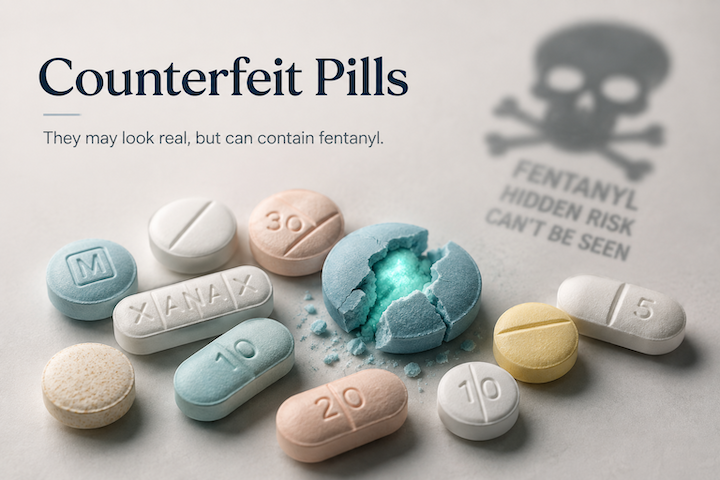
A large share of pills sold as Percocet, Xanax, or Adderall contain fentanyl instead of the labeled drug. They are pressed to look correct, down to the imprint, color, and shape. There is no way to identify one visually. Many of the people we treat never intended to use fentanyl at all.
Additional resources: SAMHSA National Helpline · NJ Department of Health Harm Reduction https://www.nj.gov/health/populationhealth/documents/fentanyl-flyer.pdf
Counterfeit pills.
A large share of pills sold as Percocet, Xanax, or Adderall contain fentanyl instead of the labeled drug. They are pressed to look correct, down to the imprint, color, and shape. There is no way to identify one visually. Many of the people we treat never intended to use fentanyl at all.
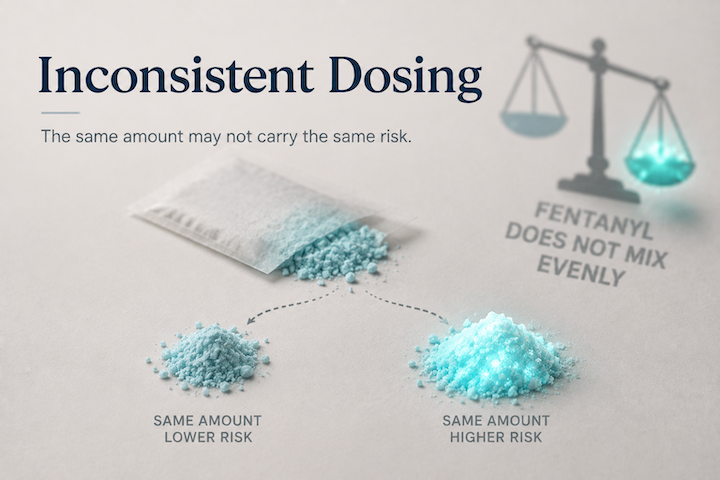
Inconsistent dosing.
Fentanyl does not mix evenly into a batch. Two portions from the same supply can differ dramatically in potency. This is why using the same amount you always use offers no real protection.
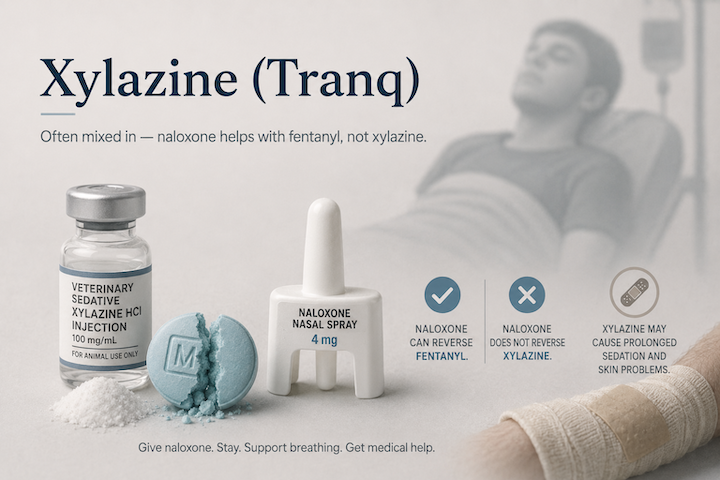
Xylazine, known as tranq.
A veterinary sedative now widely present in the fentanyl supply, including in New Jersey. It is not an opioid, so naloxone will not reverse its effects, though naloxone should still always be given because fentanyl is almost always present alongside it. Xylazine causes prolonged sedation and severe skin wounds that can appear away from injection sites. It also complicates withdrawal, which detox facilities need to know about in advance. LEARN MORE
https://www.nj.gov/health/populationhealth/documents/xylazinetrifold.pdf
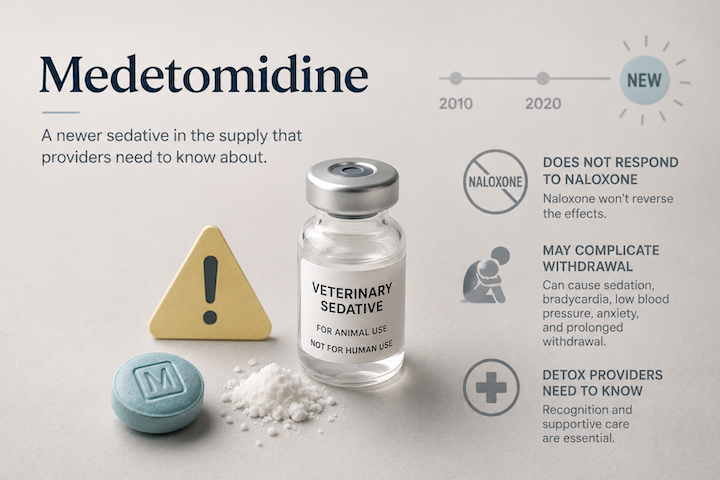
Medetomidine.
A newer veterinary sedative that state health officials have begun identifying in the New Jersey drug supply alongside xylazine. Like xylazine, it does not respond to naloxone. Withdrawal from it has been reported as unusually severe, and because it is recent, many detox facilities are still learning to recognize and manage it. If you have been using fentanyl in the past several months, tell your detox provider that sedative adulterants may be involved.
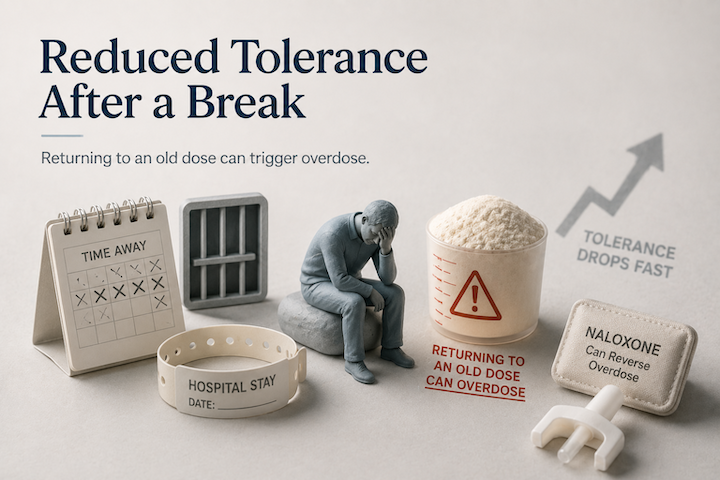
Reduced tolerance after any break.
Time in jail, a hospital stay, or a stretch of abstinence all lower tolerance quickly, and returning to a previous dose is a common overdose scenario. This is also why Vivitrol carries an overdose warning. While it is active you are protected, but if it wears off and you use at your old amount, the risk is elevated. We cover this directly with every patient and make sure naloxone is in the house.
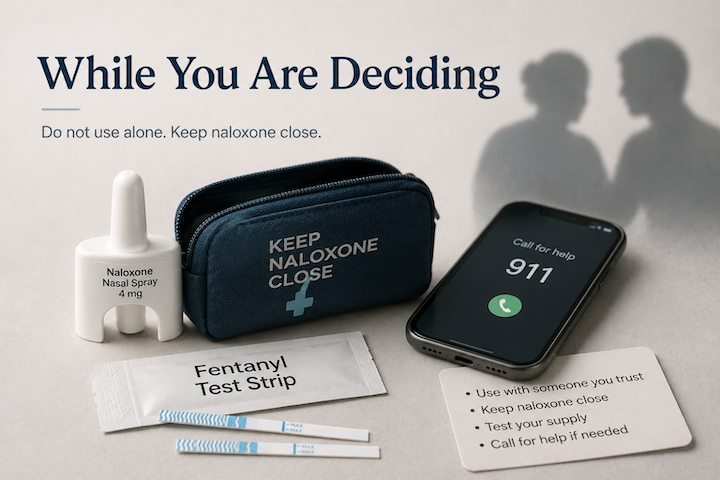
While you are deciding:
Do not use alone. Keep naloxone accessible and make sure someone nearby knows where it is. Fentanyl test strips are legal in New Jersey and available free through several county programs. None of this replaces treatment, but you have to be alive to get to treatment.
MENTAL HEALTH & CO-OCCURRING CONDITIONS
Treating What's Underneath
Opioid use disorder rarely travels alone. Depression, PTSD, anxiety disorders, and chronic pain conditions are common among the people we treat. Sometimes they precede the substance use, sometimes they are deepened by it, and usually both are true.
Treating one without the other does not hold. If the underlying depression goes untreated, the reason to use is still sitting there when treatment ends.
Our clinical team assesses for co-occurring conditions at intake and integrates that treatment into your program rather than sending you elsewhere for it. Where medication management for a psychiatric condition is appropriate, our physician coordinates it.
Chronic pain deserves specific mention. A meaningful number of people we treat began with a legitimate prescription for a real injury. That pain does not disappear because the opioid did. We work with you on it honestly rather than pretending it is not there.
Fentanyl in New Jersey and Ocean County
New Jersey has made real progress. According to NJ CARES, the state recorded 1,312 suspected drug overdose deaths in 2025, a 27 percent reduction from 2024 and more than a 50 percent decrease from the pandemic-era peaks of 2020 and 2021.
That progress is worth recognizing, because the picture many people carry of New Jersey's overdose crisis is several years out of date. Expanded access to treatment, naloxone, harm reduction, prevention, recovery support, and other public-health efforts have occurred alongside a substantial decline in overdose deaths.
The crisis has not ended, however, and the drug supply itself has changed. The New Jersey Department of Health reports that the majority of overdose deaths in the state involve fentanyl or one of its analogs. Fentanyl is a synthetic opioid more than 50 times as potent as heroin, and today's overdose deaths are increasingly complicated by substances such as xylazine, medetomidine, and other adulterants.
For people using illicit drugs in Ocean County and throughout New Jersey, the risk is no longer limited to fentanyl alone. An increasingly unpredictable drug supply can contain multiple substances, making overdose, sedation, withdrawal, and treatment needs more complicated.
Sources
https://www.njoag.gov/programs/nj-cares/
https://www.nj.gov/health/populationhealth/opioid/
Why People Choose Renova Recovery
Joint Commission accredited. The recognized national standard for behavioral healthcare quality, earned through independent on-site survey. Most outpatient programs in New Jersey do not carry it.
LegitScript certified. Independently verified as a legitimate treatment provider, which is also what allows us to advertise on Google. In an industry with documented patient brokering problems, that verification is worth checking for at any facility you consider.
We answer the phone and we move fast. Fentanyl does not give people a long window between deciding to stop and changing their mind. When you call, you speak to someone who can actually assess you, not a call center that sells your information to whoever is buying.
We will tell you the truth about fit. If you need a level of care we do not provide, or a medication we do not offer, we will say so and help you find it. We would rather refer you correctly than admit you incorrectly.
Local. Brick Township, minutes from Point Pleasant, Toms River, and the Jersey Shore communities we serve. Treatment close to home means family can be part of it.
Do you offer detox for fentanyl?
No. Renova Recovery is an outpatient treatment center and does not provide detoxification. We help you find an appropriate licensed detox facility, coordinate with their team, and begin your treatment as soon as you are discharged.
How long does fentanyl withdrawal last?
Acute withdrawal typically begins within hours of the last dose and runs roughly 5 to 10 days, though fentanyl's fat solubility can extend it. Post-acute symptoms such as sleep disruption, low mood, low energy, and intermittent cravings can continue for weeks. This is normal and treatable, and it is a major reason structured treatment after detox matters.
Can I take Vivitrol if I have been using fentanyl?
Yes, but the timing is critical. You must be fully opioid-free first, often 10 to 14 days or longer for fentanyl, which is more than other opioids require. Starting too early causes precipitated withdrawal. Our physician assesses readiness individually and coordinates the timing with your detox facility.
What is xylazine, and does it change treatment?
Xylazine is a veterinary sedative found mixed into much of the current fentanyl supply. It is not an opioid, so naloxone does not reverse it, though naloxone should still always be given. It can prolong and complicate withdrawal and cause serious skin wounds. Tell your detox provider if you suspect it, since it changes how they manage your care.
Do you prescribe Suboxone or methadone?
No. Renova offers naltrexone/Vivitrol only. If buprenorphine or methadone is the right fit for you, we will help you find a provider who offers it. If you are already stable on one and want therapy and structure, call us. We can often work alongside your prescriber.
How long is treatment?
It varies. Partial care typically runs several weeks, IOP commonly 8 to 12 weeks, with outpatient continuing after. Your clinical team builds the timeline with you based on progress rather than a preset number.
Can I keep working during treatment?
Often yes, particularly in IOP and OP, which are built around flexible scheduling. Partial care is more demanding and usually requires time away. We will be realistic with you about what your situation allows.
Do you take my insurance?
We are out-of-network with most commercial PPO plans, which frequently provide substantial coverage for outpatient treatment. Call us and we will verify your specific benefits and explain your actual out-of-pocket cost before you commit to anything.
What if I have been to treatment before and it did not work?
That is common and it is not disqualifying. Most people who reach lasting recovery have prior attempts behind them. What matters is understanding what went wrong last time and building the plan differently.
What if I am not ready to stop?
Call anyway. There is no pressure and no commitment on a phone call. In the meantime, do not use alone, keep naloxone in the house, and know that fentanyl test strips are legal in New Jersey. We would rather you call us in six months than not be able to.
Your Questions Answered
Fentanyl Does Not Give You Unlimited Time
You do not have to have it figured out before you call. You do not need to know what level of care you need, whether your insurance covers it, or what happens next. That is our job.
One phone call. We will tell you what we can do, what we cannot, and what your options are either way.
Confidential
Supportive
Quick Response